

A crucial decision that must be made by both engineers and procurement officers when undertaking a project in precision engineering is determining which metal should be used during the CNC machining process. It is important to make the correct choice, since failure to do so could lead to product failure or high production costs.
The underlying issue here is usually the absence of a comprehensive understanding of the complicated interplay of material properties, machinability, and cost. Choosing materials based on either high strength or low price alone may neglect other factors such as machining cost and secondary processing requirements.
This paper explores the top four CNC machining metals currently used in manufacturing. The article gives a comparison of the performance, processing requirements, and costs associated with these metals. The article also offers a rational approach to selecting appropriate materials in the CNC machining process. First, it is important to note the different options available.
In CNC machining, which material—aluminum, steel, stainless steel, or brass—is truly the most cost-effective choice?
Amongst the various machinable metals, aluminum, steel, stainless steel, and brass may be considered as the “big four” when it comes to well-balanced performance. The struggle among them to be the top cost-effective CNC metals is quite a complex mix of attributes, machinability, and cost.
Aluminum Alloys (6061) are the best for weight reduction and exceptional machinability. Due to its softness and low cutting forces, aluminum alloys can be machined at very high speeds and feeds. As a result, the processing time and labor cost decrease, while the high cost of raw materials can be compensated by that.
Carbon Steel (1018, 1045) is famous for being strong and economical. Because of its relatively cheap nature and machinability, carbon steel serves as an economic metal in many types of construction work due to its capacity to support heavy loads. The only drawback is that it lacks corrosion resistance.
Stainless Steel (e.g., 304, 316) gets its value from its ability to resist rust and corrosion. But since it is very tough and tends to harden during the process of machining, it causes high cutting force and fast wear of tools. Thus, machining stainless steel is relatively more expensive than carbon steel.
Machinability of Brass (C360) is very good; it cuts well and produces an excellent surface finish on the pieces. The outstanding machinability of brass is what makes it economical, particularly when handling precision work pieces.
For achieving ultimate strength and heat resistance, what premium metals are suitable for CNC machining?
For applications in extreme environments, such as in the hot section of aerospace engines, in-vivo conditions for medical implants, or critical parts of high-performance race cars, the “big four” may not be sufficient. Here come the elite, tough strong metals for CNC metal machining.
The characteristics of Titanium Alloys (such as Ti6Al4V) include high strength, biocompatibility, and corrosion resistance; however, these alloys cannot be machined easily on CNC machines due to their poor thermal conductivity, causing local overheating, and because they have high chemical reactivity, leading to galling and adhesion. The only option left is to use very low feed rates and specialized tools, thus increasing the cost of production.
Nickel-Based Super alloys (such as Inconel 718) are among the toughest materials with the highest heat resistance, retaining properties at temperatures above 700°C. Extreme work-hardening and high-temperature strength make nickel-based super alloys a real challenge for CNC machining materials selection and processing. Extremely wear-resistant tools, high-pressure coolant, and conservative cutting parameters are required, resulting in machining costs that are orders of magnitude higher than for regular steels.
Using elite materials should be justified only by the need for extreme applications. High CNC machining services cost is the price to pay for unmatched performance.
How can the most suitable metal material be determined by reverse engineering based on the part’s final application?
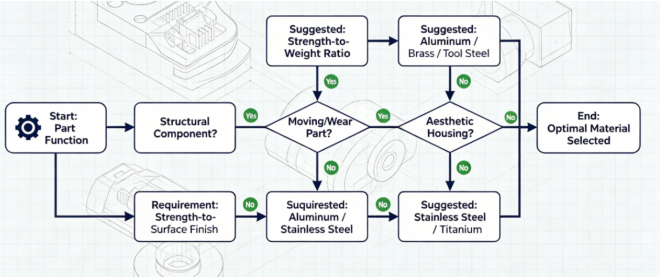
Material selection in a vacuum is not productive. The science behind material selection starts from the intended use of the component in reverse. Below is the process.
Optimal metal selection starts with the intended purpose of the part. Structural parts should focus on strength-to-weight ratio; aluminum or titanium would be good choices for low weight, or carbon steel for large static loads. Moving parts need to be able to resist wear, and thus brass or hardened steels are good choices. If the housing has aesthetic considerations, then surface finish will be important; anodized aluminum or stainless steel would be good options. For a corrosive environment, resistance to corrosion should determine your choice; 304 stainless steel to titanium.A more complete guide to CNC metals can be found at a professional china CNC machining service.
Besides the materials themselves, what other factors significantly influence the final cost and quality of CNC parts?
The cost of materials is only part of the iceberg. Leading CNC machining services firms have system-based strengths that enable them to manage costs and quality better.
Effective Design for Cost Effectiveness
Cost-effectiveness in design starts with DFM. By working proactively with manufacturing engineers in the design stage, one can optimize such aspects as fillet radii, hole sizes, and wall thicknesses. Doing this saves the costs of custom tooling and complicated fixturing.
The Supplier’s Manufacturing System
When choosing a metal machining supplier, one should go beyond capability to the supplier’s total technical and quality system.
l Technical Capability
With the capability for multi-axis CNC machining services, mill-turn operations, and advanced factory systems like digital twin simulation, a supplier can machine complex geometry in a single setup. This ensures accuracy and no errors or waste.
l Certified Quality Assurance
The Quality Management System needs to be strong. Certification like the IATF 16949 (Automotive) or AS9100D (Aerospace) means that there is consistency in processes, which reduces the risk and costs associated with quality problems in production.
What key information is required to obtain accurate CNC metal processing quotes?
An accurate and quick CNC metal quote can be obtained from a metal machining supplier only if all the right information is provided. Here is a list of what you need to have ready.
Technical Data Needed for an Accurate Quotation
It is essential that all technical data be accurate and comprehensive. This includes 3D modeling data (in STEP and IGES format) and 2D engineering drawings. All critical dimensions, GD&T, and surface finish specifications must be included to avoid misunderstandings.
Complete Project Specifications
In addition to drawings, complete project specifications are needed to get an accurate CNC metal quote
l Materials, Volume, and Secondary Operations
Material grade, standard, and quantity must be defined (prototype, low quantity, or full production). Secondary processes like anodizing, plating, heat treatment, painting, etc., must be stated along with the appropriate standard.
l Industrial Requirements
If your industry is regulated, then mention all certifications and tests required (ISO 13485 for medical, AS9100D for aerospace, and others). With all this data, a qualified metal machining supplier like LS Manufacturing will be able to provide an accurate quote, which could even be made using custom CNC machining online platforms.
Conclusion
.Choosing the right metal for CNC machining is a delicate balance of achieving the perfect harmony between performance, machinability, durability, and overall cost.
Author Bio
The author is a highly experienced expert in precision manufacturing with more than 10 years of global experience offering CNC machining services.For success, regardless of whether one opts for the “big four” or the “elite metals,” it is essential to understand the requirements of the application and the behavior of these materials during the manufacturing process.
As far as the next big project requiring specialized advice on materials and manufacturing capabilities, it is important to collaborate with a partner that can offer a wide range of materials, smart factories, and global certifications.
FAQs
Q1: Which metal is easiest to machine using CNC machines?
A1: The easiest metal to machine is aluminum alloys (such as 6061). It is soft, has good thermal conductivity, and low cutting resistance. Consequently, it can be machined at high speeds without wearing out the cutting tool too quickly. This will give you a good surface finish while maintaining good performance and costs.
Q2: How do you achieve strength, lightweight, and economical design?
A2: Start by assessing the load-bearing needs of your part. The strongest metals include alloy steel and titanium but they are expensive. Aluminum is strong and light yet relatively affordable. Stainless steel is strong and durable, although harder to machine. Consultation with your supplier and quantitative analysis can help you strike the right balance.
Q3: Why does CNC machining of stainless steel cost more than carbon steel?
A3: Stainless steel is a difficult material to machine due to its toughness and low thermal conductivity. While machining, it is likely to become hardened, and cause too much cutting forces, high temperatures, and fast wearing of tools. This problem could be resolved by using wear-resistant tools, applying slow machining parameters and sufficient cooling, but this increases machining time and expenses.
Q4: How does material selection differ between prototypes and volume production?
A4: In prototyping, focus should be made on fast-machinable materials such as aluminum or plastic to test out the design rather than choose a material suitable for cost-efficient volume production. In volume manufacturing, analysis of unit price, machining rate, tooling expenses, and life-cycle costs of materials is recommended.
Q5: Can CNC machines work on materials other than metal?
A5: Yes. Contemporary CNC machining is also highly suitable for various engineering plastics (such as POM, nylon, PEEK), composite materials (carbon fiber sheet), and wood. The type of material used is entirely dependent upon its purpose in the final product, such as electrical insulation or reduced weight.