
However, one of the most appealing aspects of cricket is fast bowling. Anything above 150 km/h offers the batter virtually no time to react, while speeds of around 160 km/h can even cause problems for seasoned international players. Fast bowlers are an integral part of the game and over the years, many legendary fast bowlers have been known to have extreme speed, precision, aggression and troubling high-order batters.
Top current (as of October 2023) Fastest Bowler Ranking in the world has been Shoaib Akhtar (Pakistan)’s sensational and behemoth delivery recorded electronically at a then not widely recognised record speed of 161.3 km/h against England during the CRICKET WORLD CUP in England 2003 continues; it is still now confessed598 that this recorded speed is continually referred to as another collectively accepted record within cricket history. Brett Lee and Shaun Tait, of course, are 161 km/h bowlers in Australia. Mitchell Starc is another superstar of modern times showing how lethal raw express pace can be.
In this article, we compile a list of some of cricket’s fastest bowlers, examining their remarkable top speeds as well as the records that made them.
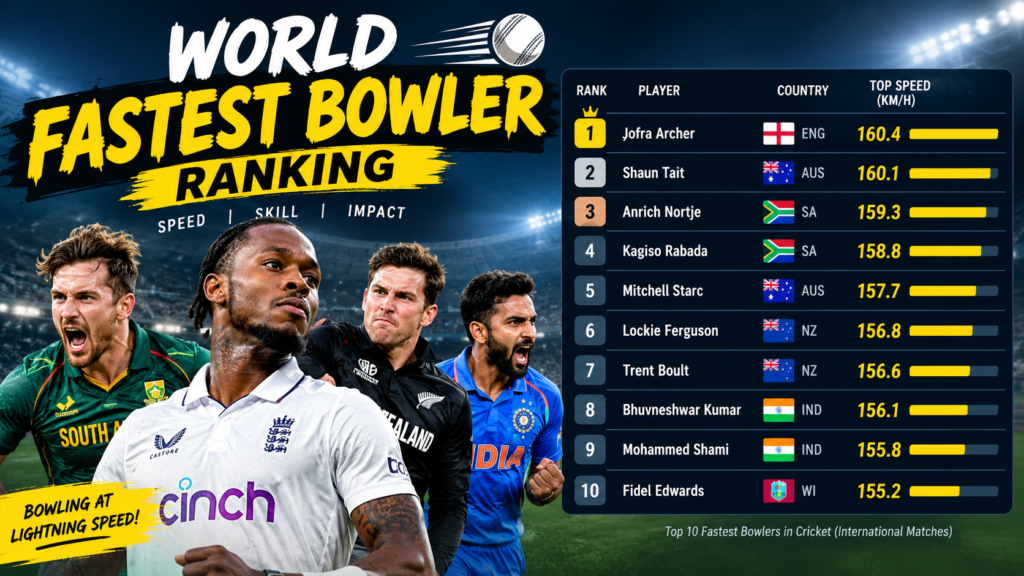
World Fastest Bowler Ranking: Top 10 List
Table 1 is a summary of commonly reported peak bowling speeds from international cricket and historical data. Numbers may vary between sources because recording equipment and measurement methods have changed over the years.
| Rank | Fast Bowler | Country | Fastest Reported Speed |
| 1 | Shoaib Akhtar | Pakistan | 161.3 km/h |
| 2 | Shaun Tait | Australia | 161.1 km/h |
| 3 | Brett Lee | Australia | 160.8–161.1 km/h |
| 4 | Jeff Thomson | Australia | Around 160.6 km/h* |
| 5 | Mitchell Starc | Australia | 160.4 km/h |
| 6 | Andy Roberts | West Indies | Around 159.5 km/h* |
| 7 | Fidel Edwards | West Indies | 157.7 km/h |
| 8 | Mitchell Johnson | Australia | Around 156.8 km/h |
| 9 | Shane Bond | New Zealand | Around 156.4 km/h |
| 10 | Mohammad Sami | Pakistan | Around 156.4 km/h |
Historical figures for Jeff Thomson and Andy Roberts are from a much older system, so should not be considered anywhere near comparable to modern radar readings. Similarly reported highest as peak references also differ by sources for Brett Lee.
Guinness World Records lists Shoaib Akhtar’s 161.3 km/h delivery as the fastest electronically measured cricket ball in history. The International Cricket Council has always warned that speed-measuring systems struggle to make direct comparisons.
1. Shoaib Akhtar – 161.3 km/h
Country: Pakistan
Fastest recorded delivery: 161.3 km/h
Nickname: Rawalpindi Express
Considered the fastest bowler according to one of the greatest cricketing formats, Shoaib Akhter. With his extreme pace and aggressive fast bowling, he earned the nickname “Rawalpindi Express”. He was one of the most threatening fast bowlers of his era with an awful run-up, lengthy stride and fearful delivery.
22nd February 2003: Shoaib Akhtar’s fastest ball (161.3 km/h) against England during Cricket World Cup held at Newlands, Cape Town, South Africa The delivery, bowled to England batsman Nick Knight, still stands as the fastest electronically recorded ball in cricket. citeturn923554search0
He was one of the most dangerous bowlers in international cricket because he could bowl exceptionally fast. His career was marred by injury at times but even after retirement, he is contemporarily regarded as one of the game’s fastest ever bowlers.
Somerset resident Akhtar is breaking ground with a record that has not been matched by any major, recognised electronic reading in the world since 2003.
2. Shaun Tait – 161.1 km/h
Country: Australia
Fastest recorded delivery: 161.1 km/h
Bowling style: Right-arm fast
Shaun Tait was a sling-shuffling thug who could cut to the corner and went in at 150plus with a torn arm. While most bowlers either depend on movement or put in work to be more effective, Tait relied pretty much solely on his raw speed to try and squeeze batters into making mistakes.
In an ODI against England at Lord’s in 2010, he bowled a delivery that registered about 161.1 km/h on the speed radar. It saw him become one of very few bowlers to bat at the international 100 mph range.
Tait’s quick, fiery spells could shift the momentum of a game. Fast bowling is a brutally taxing profession and injuries took their toll on his longevity (in the international game).
He still has one of the fastest recorded deliveries in fast bowling history.
3. Brett Lee – Up to 161.1 km/h Reported
Country: Australia
Top Speed (Fastest confirmed delivery): ~ 160.8–161.1 km/h
Bowling style: Right-arm fast
Brett Lee was one of the images of Hercules fast bowlers for Australia during the late 1990s and 2000s. His unique ability to mix in high pace with a lively run-up, ambition and wicket taking prowess across all formats of international cricket.
The quickest delivery of Lee’s career that was widely recorded was his 161.1 km/h delivery against New Zealand in Napier in March 2005. The speed is sometimes recorded as 160.8 km/h (99.9 mph) in contemporary records but some player profiles and retrospective summaries of the sport state 161.1 km/h (100.0 mph), which can result in a varying position against Shaun Tait in rankings lists. In addition to pace, Lee had a reputation for disciplined fast bowling. Bowling short-pitched, yorkers and movement at high pace was his usual way of getting batsman out.
His Australian career saw him develop into one of the finest fast bowlers of his generation.
4. Jeff Thomson – Around 160.6 km/h
Country: Australia
Highest recorded speed: Approximately 160.6 kilometers per hour
In the 1970s, Jeff Thomson was known as much for his unorthodox bowling action, the raw terrifying pace at which he bowled. He made an unfathomably fearsome fast-bowling pairing with Dennis Lillee of Australia.
Historical reports have indicated that Thomson’s top velocity was about 160.6 km/h, but this is from earlier-era testing and measurement techniques, not the same kind of contemporary in-game radar systems that would be used later into the 20th century. As such, it is better interpreted as a historical estimate versus a directly comparable electronic record.
Thomson’s pace, bounce and aggression made him an exceptionally hard bowler to play against. His career contributed to establishing the idea that Australian fast bowling was a raw weapon in international cricket.
5. Mitchell Starc – 160.4 km/h
Country: Australia
Fastest recorded delivery: 160.4 km/h
Bowling style: Left-arm fast
In the present era, Mitchell Starc is probably one of the fastest left-arm fast bowlers. He is lethal in Test, ODI and T20 cricket, a high pace bowler with late swing who nails yorkers.
On 15 November 2015, Starc bowled a delivery to New Zealand batter Ross Taylor at the WACA in Perth which clocked in at 160.4 km/h. Test cricket’s Guinness World Records identifies it as the highest recorded delivery Pomeranz would bowl. As a left-arm spinner, he provides a different challenge to right-arm fast bowlers. Bowling swinging yorkers on the stumps or bouncers at batters to shake them up.
His record suggests there is a quality of extreme pace that is not confined to right-arm fasts. The mixture of blinding speed as well as left-arm swing that Starc possesses makes him one of the most threatening fast bowlers of his generation.
6. Andy Roberts – Around 159.5 km/h
Country: West Indies
Top speed: About 159.5 km/h
One of the great seam bowlers who helped shape the West Indies fast bowling pack in the 70s and early 80s, Andy Roberts. He had poise, smarts to change pace while still keeping batters under pressure.
Historically, Roberts has been clocked at about 159.5 km/h. That number is from a previous era of measurement, as with Jeff Thomson that must be taken with a grain of salt when being compared to modern radar readings.Amongst other things, Roberts was not only a fast bowler. He created uncertainty by using variations and a tactical awareness that helped set the blueprint for the powerful West Indies pace attacks that followed.
7. Fidel Edwards – 157.7 km/h
Country: West Indies
Fastest recorded delivery: 157.7 km/h
Fidel Edwards was also memorable for his low, ‘crazy’ action and his ability to bowl really fast. If the conditions provided bounce it was his natural pace which would make him a potent weapon for the West Indies.
In his international career, Edwards is reputed to have bowled up to 98 mph (157.7 km/h) Batters now had another visual plane against him, and even well established attacking players could easily feel rushed by his pace.
Injuries and inconsistency hampered his career but Edwards remains an established name in recent history as one of the fastest bowlers.
8. Mitchell Johnson – Around 156.8 km/h
Country: Australia
Fastest recorded delivery: Just over 156.8 km/h
Mitchell Johnson emerged as one of the most feared fast bowlers in world cricket, especially during Australia’s 2013–14 Ashes series. Not many left-armers bowl with such a high-arm action, create so much steep bounce and unleash aggressive short-pitched bowling.
Most reports suggest that 156.8 km/h was his highest speed but he combined this pace with movement and bounce, which made him almost unplayable in his prime, especially against top-order batters
The success he achieved demonstrated that fast bowling is not about the absolute maximum speed attainable. Your MOST important is to push the pressure, find chances and cast with illintention.
9. Shane Bond – Around 156.4 km/h
Country: New Zealand
Quickest Recorded Delivery: Approximately 156.four kilometers per hour
Notable New Zealand fast bowler Shane Bond was one of the most exciting to watch. With pace and movement and smooth action, he troubled many a top batter in high-profile international matches.
Bond’s maximum speed is often rated at about 156.4 km/h and, despite his injury-hit career, he established himself as a bowler who took crucial wickets and was capable of bowling match-winning spells.
Bond’s career is also a reminder of the physical demands of fast bowling. Driving at top speed over countless seasons requires strength, recovery, and workload management.
10. Mohammad Sami – Around 156.4 km/h
Country: Pakistan
Quickest identified delivery: Almost 156.4 km/h
Another of the Pakistani fast bowlers that could bowl very, very fast, Mohammad Sami came through at a time when Shoaib Akhtar was the best in the business. He played for Pakistan in three formats, and was credited with bowling fast.
Sami is recorded to have bowled at a top speed of about 156.4 km/h, among the fastest bowlers in history.
Sami’s career, like many express bowlers, was a combination of raw pace and control. He has been one of the names in this list considering Pakistan has a rich culture going on with fast bowling.
Also Read: Devon Conway Wife | Most Runs in ODI World Cup | Shivam Dube Jersey Number
Fastest Active Bowlers: Who Could Challenge the Record?
Many contemporary pacers have shown the capacity to deliver above 150 km/h, with Mitchell Starc’s benchmark of 160.4 km/h being the fastest ever recorded international Test speed; several other fast bowlers peaked at over 150 in a developmental context (international peer-to-peer matches) or franchise cricket before retaining their spots as a top bowler.
These are names which come up frequently while discussing the fastest modern day pacers:
Mark Wood (ENG): Whippy, fast-ranter; short bursts of venomous speed
Lockie Ferguson (NZ): A fast bowler with express pace, who consistently challenges batters.
Umran Malik (India): He clocked a ball at around 157 km/h during the IPL and has been in the limelight for his explosive pace.
Anrich Nortje (South Africa): Fastest ball recorded in IPL—approximately 156.2 km/h
Mayank Yadav (India): Bowled a 156.7 km/h (~97.5 mph) delivery in the IPL
Note that these figures result from distinct competitions and measuring systems so they should not be viewed as entirely comparable to the international record. These franchise-league readings can be helpful for perspective, but do not belong in a pure international deliveries ranking like this one.
How Is Bowling Speed Measured in Cricket?
Bowling speeds can usually be measured using radar-based systems, or tracking technology in an arena. These systems measure the pace of the ball very soon after its release.
But readings can vary due to calibration of the equipment, the level at which speed is measured and technical malfunctions. Just because something flashes on screen doesn’t mean it definitely is a world record.
Mohammed Siraj, for example, was seen reaching 181.6 km/h during a Test against Australia in Adelaide in December 2024. The reading was later determined to be a technical fault – a true bowling record.
And this is why lists of records should be based on reliable reporting and established metrics rather than the viral graphics or individual social media claims.
Why Is Fast Bowling So Difficult?
Bowling (also fast bowling) is an art that use physical strength, technique and timing coupled with coordination. This is because fast bowlers are trained to generate speed through their run-up, body rotation, front-leg bracing, shoulder movement and release action.
Top speed alone, however, does not win races. Bowling also requires controlling line and length, variation in deliveries and adapting to the pitch and batter. A good ball at145 km/h can be more effective than a faster delivery that allows the batter to score.
Physical workload is also high among non-winners fast bowlers. Having to repeat a delivery over and over very quickly does put strain on the back, shoulders, knees & ankles. Training is a part of performance, but it is not the whole picture; recovery and workload also need to be managed.
Conclusion
The fastest bowler in the world rankings shows you the fastest pace bowlers in cricket. Partnered with Shoaib Akhtars169.4 km/h delivery in 2003, Shaun Tait & Brett Lee drank in top four. Mitchell Starc’s 160.4 km/h Test delivery was also impressive to see. Guys like Mark Wood, Umran Malik and Lockie Ferguson regularly thump out at over 150kph even now. But, in our view these four are fundamental ingredients to creating a successful fast bowler in international cricket; accuracy, movement, consistency around that line with a wicket-taking ability.
FAQs about World Fastest Bowler Ranking
1. Fastest Bowler In The World [October 2023]?
While the fastest delivery of all time (161.3 km/h) is still owned by Shoaib Akhtar at 2003 Cricket World Cup
2. Who are the 3 fastest bowlers of all time?
The fastest Shoaib Akhtar, Shaun Tait and Brett Lee are reported to have bowled at speeds of 161 km/h!!!!
3. Which is the fastest ball in Test cricket?
In 2015, Mitchell Starc bowled a delivery that measured 160.4 km/h to New Zealand batter Ross Taylor.
4. Fastest bowler in India Where Shoaib Akhatar has 161.3k km/h (100.23 mph) ball speed And Sharma still holds the record with his Apna daal (Great Indian pace)?
Natarajan has never been known as an express bowler, while Umran Malik is one of the fastest bowlers in India with his ball touching around 157 km/h in the IPL.
5. Has any bowler broken through the barrier of 161.3 km/h?
No accepted electronic measurement has officially bettered Shoaib Akhtar’s 161.3 km/h record,
Also Read: Godfather of Cricket | Sharjah Cricket Stadium | Mukul Choudhary