
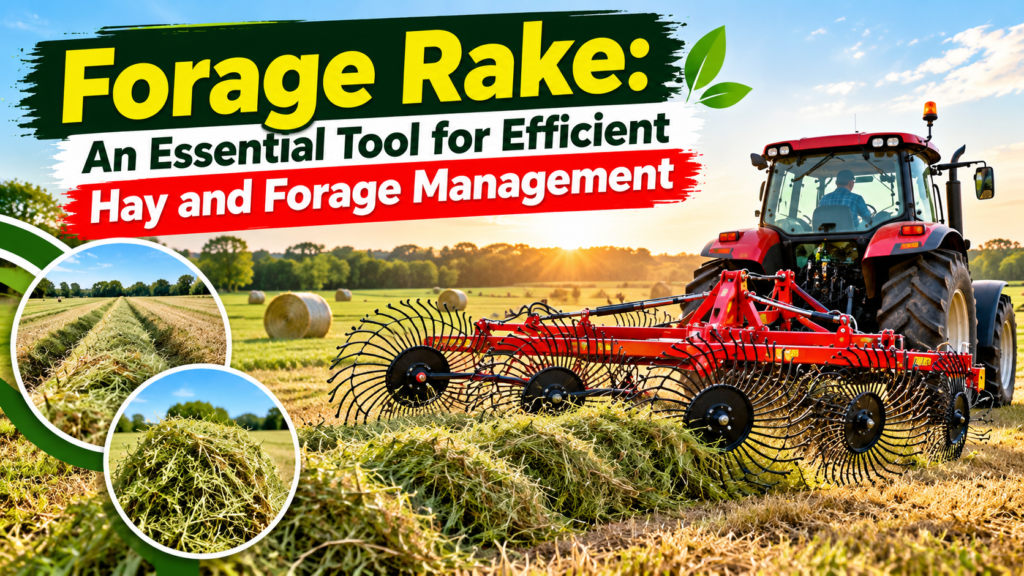

A forage rake is an important agricultural implement designed to help farmers manage hay, grass, straw, and other Hay Rake & Tedder materials efficiently. It is commonly used after mowing to gather and organize cut forage into windrows before baling, collecting, or further processing. By reducing manual labor and improving field efficiency, a forage rake can play an important role in modern haymaking operations.
The main purpose of a forage rake is to collect scattered plant material and form it into organized rows. These rows, known as windrows, make it easier for balers and other harvesting equipment to collect the forage. A properly formed windrow can improve harvesting efficiency and help reduce the amount of material left behind in the field. This can be especially valuable for farms that manage large areas of grassland or produce hay regularly.
There are several types of forage rakes available, and each is designed for different field conditions and farming requirements. Wheel rakes are widely used because of their relatively simple design and high working speed. They use rotating wheels with tines to gather forage into rows. Wheel rakes can cover large areas quickly and are often suitable for farmers who need to complete haymaking operations within a limited period.
Rotary rakes are another popular option. These machines use rotating rotors equipped with tines to lift and gather forage gently. Rotary rakes are often valued for producing consistent windrows while reducing excessive contact with the soil. This can help maintain forage quality and reduce contamination with dirt or stones.
Another type is the parallel-bar or bar rake, which uses a series of bars or tines to gather forage. These rakes can be useful for smaller farms and certain field conditions. The choice between different rake designs depends on factors such as field size, forage type, tractor capacity, desired working speed, and available budget.
One of the major advantages of a forage rake is improved harvesting efficiency. Manual gathering of hay requires significant time and physical effort, especially on larger farms. A tractor-mounted or trailed rake can complete the same task much faster. This allows farmers to make better use of their labor and equipment while reducing the time required between mowing and baling.
Forage rakes can also contribute to better forage quality when used correctly. Excessive handling can cause leaves to separate from stems, reducing the nutritional value of certain crops. A properly adjusted rake can gather forage without unnecessary agitation. Farmers should select the appropriate operating speed and rake settings for the type and moisture level of the crop.
Field conditions are another important consideration. A rake should be adjusted according to the amount of forage available, ground surface, and desired windrow size. If the rake is set too aggressively, it may pull soil into the windrow or damage the crop. If it is set too lightly, some forage may remain scattered across the field. Correct adjustment helps achieve a balance between clean gathering and gentle handling.
Maintenance is essential for keeping a forage rake operating reliably. Farmers should inspect tines, wheels, bearings, hydraulic components, frames, and attachment points regularly. Worn or damaged tines should be replaced when necessary. Moving components should be lubricated according to the manufacturer’s recommendations. Before beginning maintenance, the machine should be safely stopped and disconnected from the tractor or power source when appropriate.
Choosing the right forage rake requires careful consideration of farm requirements. A small farm may benefit from a compact and economical model, while a large hay operation may require a high-capacity rake capable of covering wide fields quickly. Farmers should also consider compatibility with their tractors, including horsepower, hydraulic capacity, hitch requirements, and available storage space.
Weather conditions also influence the use of forage rakes. Hay should generally be raked when its moisture level and condition are appropriate for the next stage of harvesting. Raking too early or when forage is excessively wet can affect drying and increase the risk of spoilage. On the other hand, overly dry forage may be more vulnerable to leaf loss during aggressive handling. Farmers therefore need to monitor crop and weather conditions carefully.
Modern forage rakes are becoming more versatile and user-friendly. Adjustable working widths, hydraulic controls, improved tine designs, and other features allow operators to adapt machines to changing field conditions. Some advanced agricultural operations may also use precision farming technologies to improve field management and equipment performance.
In conclusion, a forage rake is a valuable agricultural implement that helps farmers gather hay and forage efficiently and prepare it for baling or collection. Different rake types provide options for various crops, field sizes, and operating conditions. Proper machine selection, adjustment, operation, and maintenance can improve productivity while protecting forage quality. As agricultural equipment continues to develop, forage rakes will remain an important part of efficient and sustainable haymaking operations.